Four rules for toy storage
- Low and reachable. Everyday toys belong at the child's height. If they can't reach it, they can't put it back.
- Easy to see. Open bins, clear containers and forward-facing books help kids find what they want without dumping everything out.
- One kind per container. A bin for cars and a bin for blocks is easier to tidy than one bin for everything.
- Fewer containers than you think. Every bin is one more thing to sort. Store extras in a closet and rotate them.
Common storage types
| Type | Good for | Watch for |
|---|---|---|
| Low open shelves | Displaying a few toys at a time, puzzles, sets with trays | Anchor to the wall even when short |
| Cube units with bins | Sorting many toy types into one unit | Heavy bins on top raise the tipping risk, so keep heavy toys low |
| Open baskets and fabric bins | Soft toys, balls, dress-up clothes, larger blocks | Deep bins become dumping grounds; shallow is often better |
| Clear lidded boxes | Small pieces, art supplies, sets that should stay together | Keep boxes with small parts out of reach of children under three |
| Forward-facing book racks | Picture books with covers showing | Hold fewer books, so rotate them |
| Toy chests | Large, bulky toys | Use a lid support that holds the lid open in any position, or choose a chest with no lid |
| Wall hooks and pegs | Bags, costumes, aprons | Mount at a safe height and avoid hooks at a toddler's eye level |
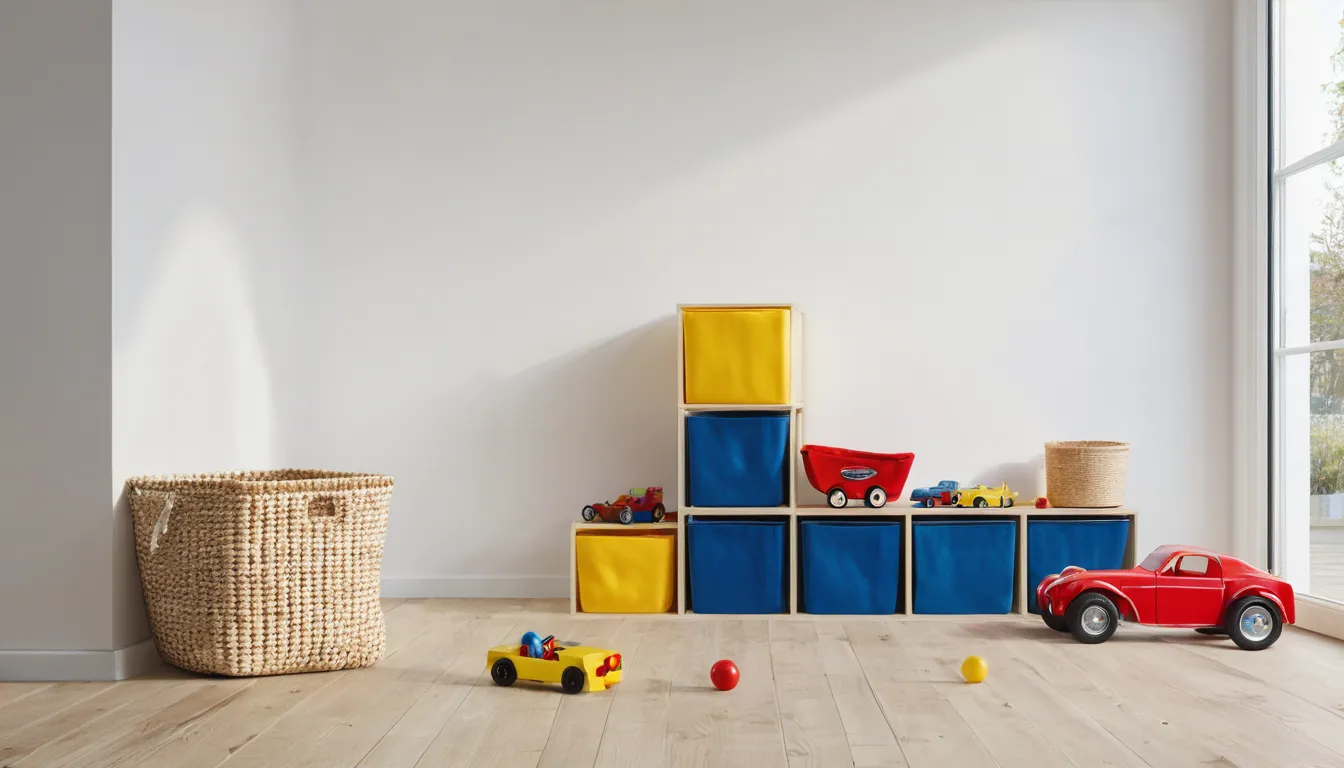
Match the container to the toy
Large, light toys such as stuffed animals and balls suit big open baskets. Medium toys such as cars, figures and blocks do well in shallow bins, where kids can see the whole collection at once. Small pieces such as beads, small bricks and game parts need lidded boxes, and those boxes should live higher up if a baby or toddler shares the room.
Some toys come with their own storage, such as a puzzle box or a train set case. Keep using it if it works. If the lid breaks or the box is hard for kids to open, move the toy into a simple bin with a label.
A note on toy chests
Toy chests with heavy hinged lids can fall on a child's head or neck, and a child can get trapped inside some chests. US safety guidance recommends a lid support that keeps the lid open in any position, ventilation holes or gaps, and no latch that locks. If you have an older chest, consider removing the lid, or use open bins instead. See the safety checklist for more.
Shelf height and weight
Put heavy items on the lowest shelves. That makes the unit harder to tip and keeps heavy things from falling on a child. Use upper shelves for light items or for things that should only come down with an adult. Anchor every shelf unit to the wall, whatever its size. Kids pull on shelves, open drawers to climb, and lean on furniture in ways adults don't expect. Our anchoring guide walks through the steps.
Storage on a budget
- Use boxes and baskets you already own before buying anything new.
- Shoe boxes and food containers make good small-parts boxes once they have a picture label.
- A single low shelf and three or four bins are enough for many small playrooms.
- Secondhand furniture can work well; check for wobbles, splinters, sharp edges and old paint before using it.
Once the storage is in place, the next step is a routine that puts things back. The labels and cleanup guide covers that.